

2026 February Special Edition Newsletter
Seeking Alignment: Religious Imaginaries in the Past and Future of AI | "Happiness" Lecture |
Bill and Belle Levman Distinguished Doctoral Fellowship in Religion | Amir Hussain Profile | Catherine Maudsley Profile | BACKPACK TO BRIEFCASE 2026

February 25, 2026
Falling under the Faculty of Arts & Science program umbrella, the Backpack to Briefcase initiative connects current students with experienced alumni, to share tips and stories of career paths as new graduates look to navigate their way into professional work life. Offering the opportunity for students to ask questions and to chat with the guest alumni over refreshments, this is an invaluable way for them to learn from those who’ve been in the very same situation – as well as providing reassurance that there are multiple solutions to the challenges involved in the next steps after graduation.
We'd be delighted if you would consider participating in a future Backpack to Briefcase event! Please contact Srilata Raman, s.raman@utoronto.ca, who leads our Alumni Relations Committee; she will be very happy to discuss it with you.

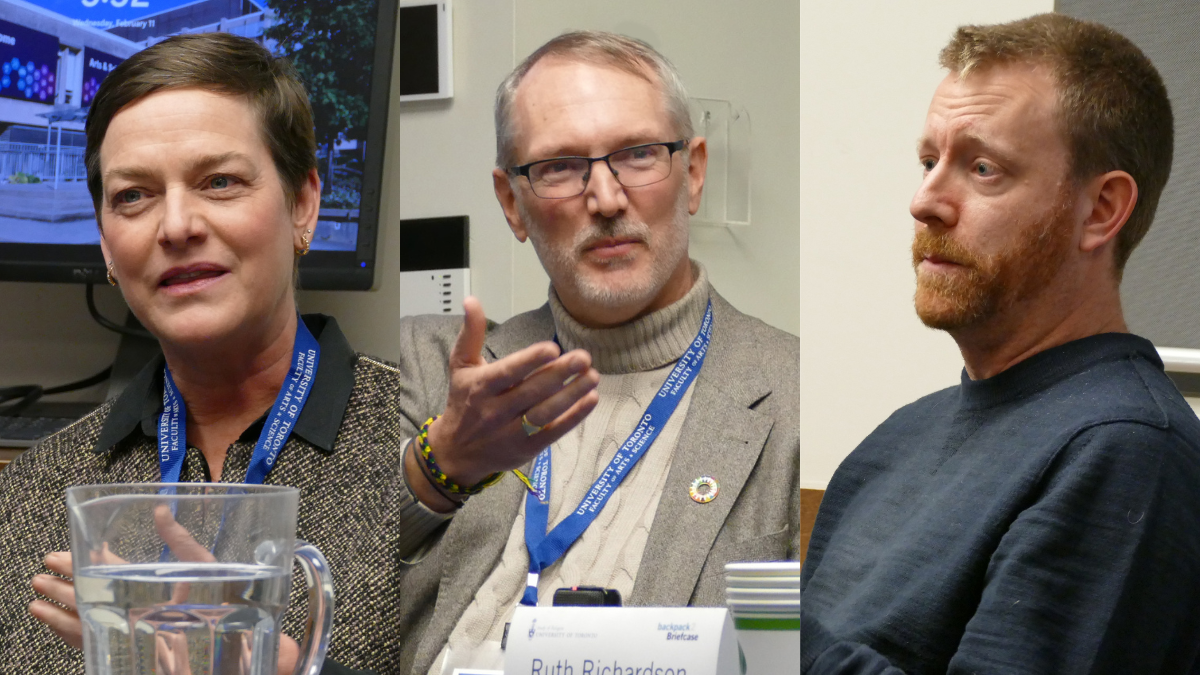
For our Backpack to Briefcase 2026 event, we welcomed back to the DSR three distinguished alumni with a wide range of achievements and experience – but who, like the students who came to hear their stories, have themselves been at that juncture between school and the big question of “what’s next?”. Simon Chambers is Head of Communications with Action by Churches Together (ACT) Alliance, a global network of Christian organizations engaged in humanitarian response, sustainable development and global advocacy work and has recently returned from the deteriorating situation in Cuba. As Associate Director, Student Information Systems at the University of Toronto, Julian Weinrib’s role is focused on leading and supporting institutional, academic, and student experience initiatives. Ruth Richardson is the Executive Director of the Accelerator for System Risk Assessment in the emerging field of systemic risk analysis, and was formerly the Executive Director of the Global Alliance for the Future of Food, a unique collaboration of over 25 foundations committed to food systems transformation. You can find more about their individual career trajectories below. You can find more about their individual career trajectories below.
 With Professor Srilata Raman, chair of the DSR’s Alumni Relations Committee, moderating the discussion, topics ranged over the transition to professional work and the related challenges and anxiety, the role of networking, and how the experience of studying religion has been at play in the roles they’ve undertaken.
The overarching themes that emerged were “say yes” – to things that might not seem at first blush to be necessarily the ‘right’ strategy, such as a temporary opportunity that doesn’t offer certainty or tick all the boxes – and the related notion of staying open and not being afraid to ask questions. As Julian noted, “Don’t underestimate the impact of reaching out to someone and saying, ‘I'm really interested in what you're doing and I'd like to learn something about it.’ … Most people feel that sense of, ‘I want to pass this on.’ If you don't reach out and engage, though, you're never going to know.” Simon highlighted this, too: “Start a conversation. Oftentimes they'll respond and you never know where it'll go after that. You can make some really lasting relationships that end up being helpful for you, just by reaching out and introducing yourself.” He also recommended considering volunteer work. “You never know where it will lead. The volunteer work I did brought me to the attention of people who said, hey, we think you'd be good at that. When the opportunity was there, I said yes and the door opened, and I was able to walk through it. I ended up doing things I never in a million years would have thought I would do.”
Making that step to engage is closely connected to the advice that students are so often given that they should be sure to network, even though it seems to many like an awkward undertaking. “Networking as a concept can seem daunting, it can be understood as a big, formal process,” Ruth remarked. “We need to take that kind of energy out of it. Networking is simply building relationships—it's getting to know people, meeting human-to-human. There are so many different ways to build relationships with people that may be valuable throughout your life—fellow students who can provide support, mentors who can help provide guidance, events that might lead to a job opportunity. There are so many possibilities, in ways you might not be able to imagine.”
You can be intentional about your networking, which is saying, here's a strategic opportunity: this is a person that I admire, or this is a person who’s doing good work. I want understand how they got to where they are, how they operate in their work sphere. And then there's the unintentional networking, which is saying yes a lot to opportunities. As a graduate student, I chose to do a co-op and worked in the academic advising centre. I just said, yes, I'm going to try this out, because what do I have to lose? And so I do think saying yes, being intentional, creating opportunities is a big part of networking. And through that, by doing good work and demonstrating commitment and willingness, other people will see that. — Julian Weinrib
Another factor that came into focus – and which again spoke to the importance of relationships – was dealing with the challenge of anxiety in professional contexts and finding perspective particularly at the start of one’s career. As Julian put it, “The moment when you graduate, and maybe you don't have a job lined up, and you're like, oh my goodness, everything is possible, and yet it feels like nothing is possible at the same time,” which brought a ripple of recognition from the student audience.
Many of us tend to think “I'm not good enough for that,” or “I don't know enough for that.” I think, especially for women, there is a tendency to think that we don't have enough qualifications. Every job I've had has been too big for me. I've really had to wrestle that down and say to myself, “no, you know what? I'm going to step into this opportunity and lean on those around me to figure it out. That's how I dealt with it, finding people to lean on. So I found mentors, I found friends, I found coaches. I asked myself, “what don't I know that if I knew, I would feel more confident in this job?” … My biggest challenges have just been gaining the confidence to say, “yes, I will try this, and I'm okay to fail. I'm okay to make mistakes. I'll figure it out. And those around me will help me and actually be quite forgiving where I may not know something yet.” That has proven to be true in every position I've had. — Ruth Richardson
“Imposter syndrome is a real thing,” added Simon. “So learning to trust yourself and to work with the people around you is really important.”
In her closing remarks, DSR chair Pamela Klassen thanked our alumni for saying yes to taking time out of their busy lives to come to speak with us, and commended the audience for coming to listen, to talk to, and to learn from them – “another saying yes that I wholeheartedly applaud.”
Our 2026 DSR Backpack to Briefcase Panel and Moderator
Including our guest speakers' reflections on the impact of studying religion on their subsequent professional lives.

Simon Chambers
Simon is the head of communications with the Action by Churches Together (ACT) Alliance, a global network of Christian organizations engaged in humanitarian response, sustainable development, and global advocacy work.
His career has taken him through youth ministry in the Toronto area, into consulting with the Anglican Diocese of Toronto and then into youth animation in the Anglican refugee and humanitarian organization, ultimately shifting into humanitarian communications within that group.
For over 15 years now, his work has taken him from refugee camps and subsistence farming villages to the United Nations and all points in between, including COP and the Commission on the Status of Women.
Simon has covered humanitarian responses ranging from the 2010 Haiti earthquake to the war in Ukraine, and from work with DRC refugees in Uganda to the current deteriorating situation in Cuba.
People in North America often think that religion is relatively irrelevant. But eighty-five percent of people who live on this planet are connected to a faith. In so many places, religion is the driver of life. And in so many places, it is religious leaders and religious institutions that are providing social services, that are the organizations and the people who are trusted when governments cannot be trusted. This is why you should be studying religion. — Simon Chambers

Ruth Richardson
Ruth is the inaugural Executive Director of the Accelerator for Systemic Risk Assessment (ASRA), an initiative designed to contribute to the emerging field of systemic risk analysis and response with a focus on helping decision-makers better understand, assess, and incorporate sensitivity to systemic risks.
Previously, she was the Executive Director of the Global Alliance for the Future of Food, a unique collaboration of over 25 foundations committed to food systems transformation. She has served on the Advisory Board of the UN Committee on World Food Security as well as on the Steering Committee of TEEBAgriFood led by UN Environment.
In a professional life devoted to social change and planetary health, Ruth was first Director of the Unilever Canada Foundation, the founding Chair of the Canadian Environmental Grantmakers’ Network, the first Environment Director at the Metcalf Foundation, and a lead consultant to establish The Circle on Philanthropy and Aboriginal Peoples in Canada. She was the recipient of the 2021 University College Alumni of Influence award.
Cross-cultural understanding is really important. When you're working globally—even if you're just working nationally, or in the city—we work in such a multicultural context that having this grounding really helps you understand others, where they're coming from, what motivates them, and so on. I’ve been reflecting recently on principles-based leadership in the sense that if you have a set of guiding principles— for your initiative, for your organization, for your country, for your family, whatever it is—that gives you the container to figure out good decision-making. I think my appreciation for that comes from my experience of studying religion at U of T. After all, faiths have a strong set of principles, constructs that provide values- and principles-based direction. So, yes, the study of religion has shown up in my life in many different ways that I'm really grateful for. — Ruth Richardson

Julian Weinrib
Julian is the Associate Director, Student Information Systems at the University of Toronto, where he supports a team of developers, analysts, system administrators, client engagement specialists, project managers and business architects responsible for roughly 25 student and administrative systems, including the University's enterprise student information system (ROSI) and portal (ACORN).
After his undergraduate studies, he completed an MA In Higher Education at Boston College and a PhD in Higher Education Policy at the Ontario Institute for Studies in Education on the international political economy of higher education and the academic profession.
He has worked at the Ontario Ministry of Training Colleges and Universities and the Higher Education Quality Council of Ontario in policy-related roles, and progressing to roles in the Dean's Office of the Faculty of Arts & Science and the Office of the Vice-Provost, Innovations in Undergraduate Education at U of T. His work at U of T has focused on leading, enabling and supporting institutional academic and student experience initiatives including technology management and implementation, curricular and pedagogical innovations, and academic analytics.
I studied the psychology of religion, as well as early Christianity. I was very interested in the way that humans construct that world around them and the organizational aspect of it as an institution. It’s fascinating the way that humans self-organize, how they make meaning of the world. Humans organize in response to different needs and opportunities, reflecting how we understand the world around us. This is something I still think about and consider a lot in the course of my work. — Julian Weinrib
Srilata Ramam, discussion moderator

Professor Srilata Raman is chair of the DSR's Alumni Relations Committee and has served as the department's associate chair, undergraduate.
A professor of Hinduism, she works on medieval South Asian/South Indian religion, devotionalism (bhakti), historiography, hagiography, colonial sainthood, subaltern religion, famine studies and modern Tamil literature.
She is the author of Self-Surrender (Prapatti) to God in Śrīvaiṣṇavism: Tamil Cats and Sanskrit Monkeys (Routledge, 2007) and The Transformation of Tamil Religion: Ramalinga Swamigal and Modern Dravidian Sainthood (Routledge, 2022), as well as having published numerous articles and chapters, and co-authored edited volumes.
Gallery